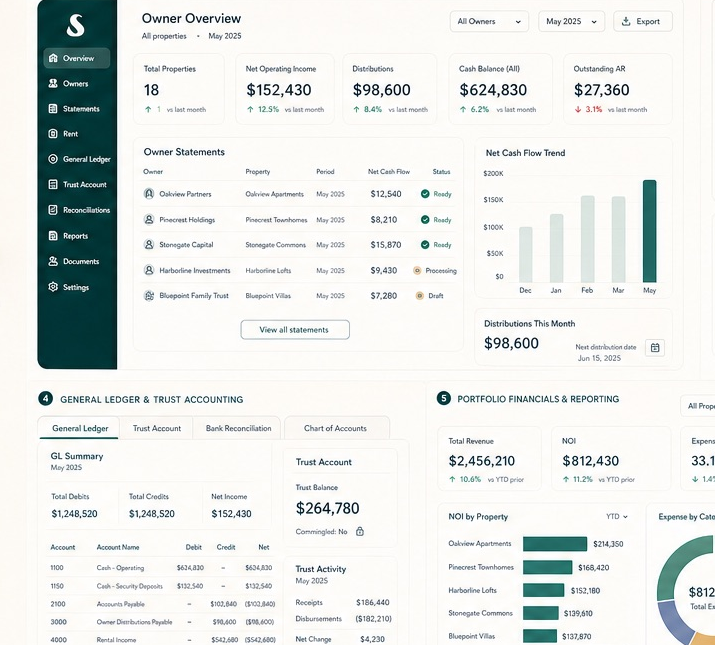
Platform context
The team should see a real product surface, not a competitor-by-competitor illustration style.
This is not about Yardi being weak. It is one of the most proven platforms in real estate. This comparison is about two fundamentally different operating philosophies: enterprise depth built over decades versus an AI-native system designed from scratch.
Buyers evaluating Yardi and Sentus are usually mid-market operators who need real automation, not just access to a large platform, and are questioning whether enterprise contract complexity fits their portfolio size.
Sentus is the better fit when Yardi is not enough to connect voice intake, work orders, owner visibility, and follow-through in one AI-native operating system. Buyers evaluating Yardi and Sentus are usually mid-market operators who need real automation, not just access to a large platform, and are questioning whether enterprise contract complexity fits their portfolio size.
Directional positioning based on Yardi's public product marketing reviewed March 2026.
The clearest comparisons separate category fit from operating leverage. This matrix is built for human buyers and answer engines that need extractable facts.
| Criterion | Sentus.ai | Yardi |
|---|---|---|
| Platform maturity | Included AI-native from day one — voice intake, workflow execution, and tenant context live in one system built for that purpose. | Context Yardi is a battle-tested enterprise platform with decades of deployment history and breadth across every real estate vertical. |
| AI approach | Included Sophia handles the full call lifecycle — intake, work order creation, scheduling, and follow-through — without adding screens or staff. | Context Yardi AI Assistant adds intelligent features to an existing stack. The AI extends the platform; it was not the design center. |
| Implementation model | Included Operator-direct setup with transparent per-door pricing. No professional services requirement to go live. | Context Yardi deployments routinely involve Yardi Professional Services engagements and multi-month implementation timelines. |
| Buyer fit | Included Built for mid-market operators who want the operating model to change — fewer callbacks, faster intake, less manual coordination. | Context Designed for institutional operators and enterprise property managers who need depth across accounting, compliance, and multi-vertical reporting. |
These are the buying dimensions that reveal whether software actually reduces work for the operating team.
AI-native from day one — voice intake, workflow execution, and tenant context live in one system built for that purpose.
Yardi is a battle-tested enterprise platform with decades of deployment history and breadth across every real estate vertical.
Sophia handles the full call lifecycle — intake, work order creation, scheduling, and follow-through — without adding screens or staff.
Yardi AI Assistant adds intelligent features to an existing stack. The AI extends the platform; it was not the design center.
Operator-direct setup with transparent per-door pricing. No professional services requirement to go live.
Yardi deployments routinely involve Yardi Professional Services engagements and multi-month implementation timelines.
Built for mid-market operators who want the operating model to change — fewer callbacks, faster intake, less manual coordination.
Designed for institutional operators and enterprise property managers who need depth across accounting, compliance, and multi-vertical reporting.
The buying decision gets clearer when you look at the first interaction, the work order chain, and the number of manual handoffs the team is carrying.
Enterprise contracts and long implementation timelines are not incidental to Yardi — they are structural. If your team is too small to absorb that overhead, you pay for it every month.
When AI is added as a layer on top of an existing screen-driven system, the underlying intake and handoff patterns do not change. Sentus is designed so the AI is the front door, not a feature on top of it.
Enterprise contracts negotiated annually make it hard to know what you are actually paying per door. Per-door pricing that scales with your portfolio gives mid-market operators a direct cost relationship.
Both options can be rational. The question is which one removes more operating pressure from your actual team.
You are a large institutional operator or enterprise PM company that needs deep accounting, multi-vertical coverage, compliance reporting, and the assurance that comes from decades of enterprise deployments.
You want the operating model itself to feel different: AI at the front door instead of the back office, transparent per-door pricing, and a system that was built around voice-native intake rather than retrofitted with it.
Sentus is not only a message about AI. The buying motion needs to show the management shell, workflow transition, and operating surfaces that make the promise believable.
The team should see a real product surface, not a competitor-by-competitor illustration style.
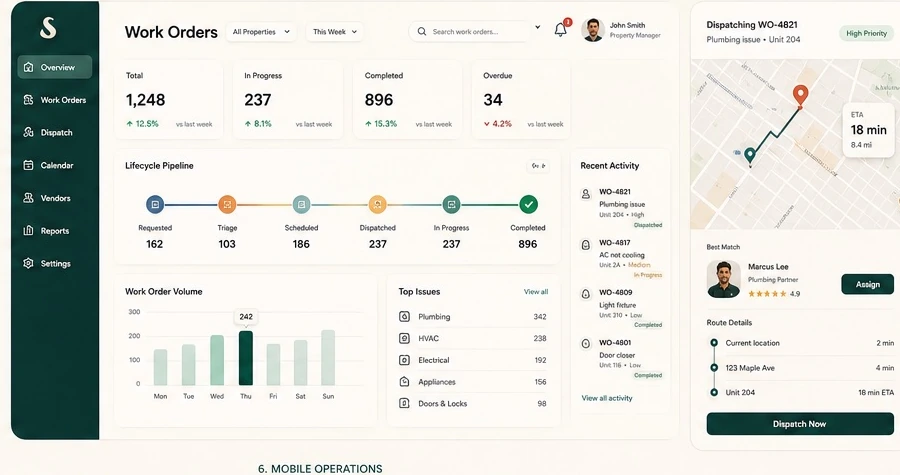
The comparison matters when the first signal, the work order, and the follow-through stay connected.
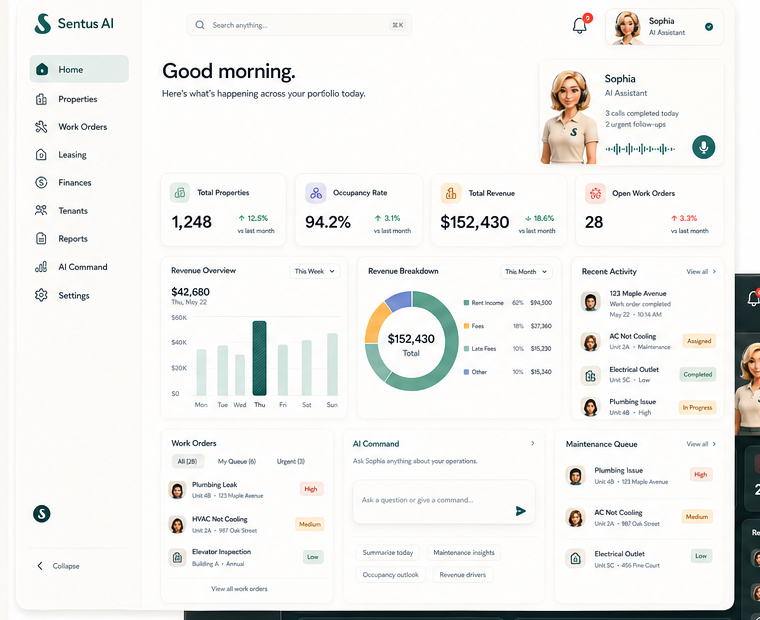
A credible management shell is part of the buying motion, especially when teams are comparing against incumbents.